.png)
European-Style Bathroom Design Guide

Updated: Aug 20

Why European Bathrooms Feel Different
There’s a certain feeling you get the moment you step into a well-designed European bathroom: quiet, effortless, and undeniably refined.
It’s not trying to impress you, and yet… it does. There’s no clutter competing for attention. No overly decorative finishes. No sense of excess. And still, everything feels elevated, almost instinctively luxurious.
European design isn’t about adding more, it’s about refining everything until nothing feels unnecessary.
So what actually makes a bathroom feel European? And why does Italian bathroom design, in particular, seem to get it so right every time?
In this guide, I’ll walk you through the details that truly define a European style bathroom, from materials and layout to the subtle design decisions most people overlook.
The Philosophy Behind European Bathroom Design: “Less, But Better”

At the heart of every great European bathroom is a surprisingly simple mindset:
Do less, but do it exceptionally well.
Instead of layering trends, colors, and decorative elements, European design focuses on clarity. Every line, every material, every detail has a reason for being there.
Nothing feels accidental. Nothing feels excessive.
And that’s what creates that sense of quiet luxury, it’s not about what’s added, but what’s been carefully left out.
The Vanity as the Centerpiece

If there’s one element that quietly defines a European bathroom vanity, it’s this:
It’s not just furniture, it’s part of the architecture.
In a well-designed European style bathroom, the vanity doesn’t feel like something that was placed into the room. It feels like it was always meant to be there.
More often than not, it’s wall-mounted, floating just enough to create a sense of openness. The proportions are precise. The lines are clean. Everything aligns effortlessly.
And that’s exactly the point.
Because when the vanity is designed this way, it does more than serve a function. It anchors the entire space, visually and spatially, while making the room feel lighter, more open, and far more refined.
Materials That Define European Luxury

One of the first things you begin to notice in a well-designed European bathroom is how restrained the material palette feels.
There’s no excess. No unnecessary mixing of finishes. Just a few carefully chosen materials, each allowed to stand on its own.
Typically, that includes:
Natural wood, like oak or walnut
Stone surfaces—marble or large-format porcelain
Matte lacquers that soften the overall look
And in Italian bathroom design, this approach becomes even more intentional.
A single slab of marble might carry the entire space. A rich wood grain might become the defining feature. Nothing competes, everything works together.
That’s where the sense of luxury really comes from.
Storage & Hidden Functionality

Here’s something most people don’t realize about European bathrooms: The space works effortlessly.
That’s because functionality is built in from the start, then carefully concealed.
Instead of visible shelving or bulky cabinetry, storage is integrated into the design itself:
Deep, full-extension drawers with internal dividers for everyday essentials
Concealed plumbing that keeps interiors clean and usable
Seamless cabinetry that maintains uninterrupted lines across the space
Even small details are considered, like drawer organization for toiletries, hidden compartments for electrical outlets, or mirrored cabinets that double as storage without adding visual weight.
Everything has a place. But nothing calls attention to itself. And that’s what creates that sense of calm, where the space feels open, uncluttered, and quietly luxurious.
Handleless Designs: The Detail That Changes Everything
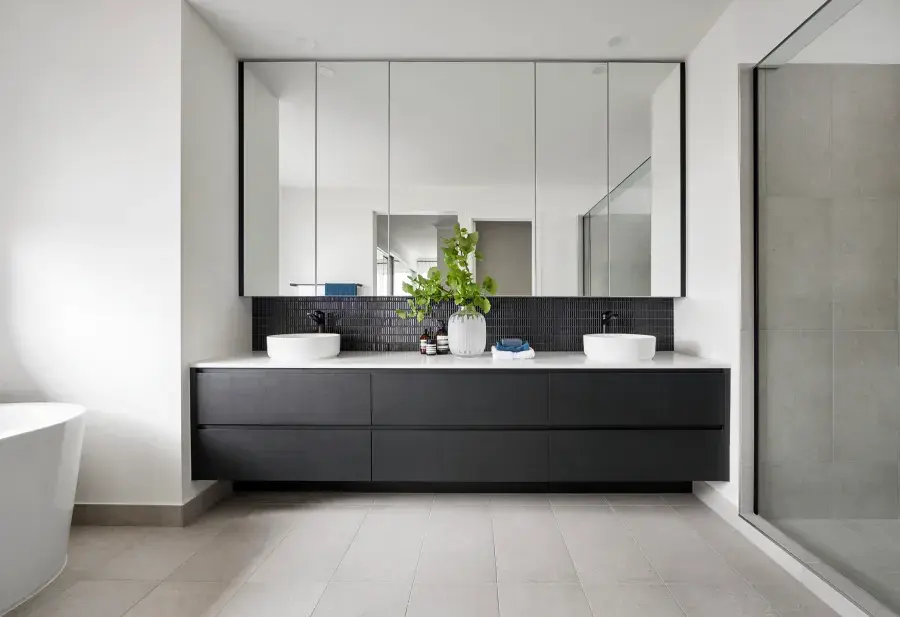
This is one of the most defining features of European bathroom vanities, and one of the most overlooked.
Instead of visible hardware, you’ll often find:
Push-to-open systems
Integrated finger pulls
Hidden channels
The result? A seamless, uninterrupted surface that instantly feels more modern, and more high-end.
It’s a small detail, but it makes a massive difference in how the space feels.
Lighting: The Quiet Luxury Element

Lighting is often the element people think about last. But in a well-designed European bathroom, it’s considered from the very beginning.
Because lighting doesn’t just illuminate the space. It defines how the space feels.
Rather than relying on a single overhead fixture, European bathrooms are designed with layers:
Soft ambient lighting that creates an overall sense of warmth
Functional lighting around mirrors for clarity and precision
Subtle accent lighting, beneath vanities or within niches, to add depth and dimension
Each layer has a purpose. And together, they create a space that feels balanced, calm, and consistent throughout the day.
There are no harsh shadows. No overly bright glare. Just a gentle, even glow that enhances the materials and softens the entire room. And that’s the difference.
Because even the most beautifully designed bathroom can feel incomplete under the wrong lighting, while the right lighting quietly elevates everything around it.
Transitional European Bathrooms: The Best of Both Worlds

Not every homeowner is drawn to a space that feels ultra-minimal, and that’s exactly where transitional European design comes in.
It offers a balance. The clarity of modern European design is softened by a sense of warmth and familiarity.
At its core, this approach blends:
The clean lines and simplicity of contemporary design
With subtle, classic elements that make the space feel more inviting
In practice, that might look like:
Warm wood tones paired with streamlined, minimalist cabinetry
Soft detailing that adds character, without heavy ornamentation
Neutral palettes layered with texture to create depth, not contrast
The result is a bathroom that feels refined, but not stark. Timeless, but not traditional.
And for many homeowners, it strikes the perfect balance. Modern enough to feel current, yet warm enough to feel like home.
Italian Bathroom Design Influence

When discussing European bathrooms, it’s impossible not to look to Italy.
For decades, Italy has set the tone for what modern bathroom design can be: refined, innovative, and deeply intentional.
What defines Italian bathroom design isn’t just how it looks, but how it’s approached.
You’ll often see:
Sculptural vanities that feel more like architectural elements than furniture
Advanced materials and finishes that push both durability and aesthetics
A seamless balance between art and everyday function
There’s confidence to it.
Materials are bold, but never excessive. Forms are expressive but always controlled. Every detail feels considered.
The result is a space that feels curated, almost gallery-like, yet still completely livable.
And it’s this approach that has shaped modern European-style bathrooms, influencing everything from material selection to how vanities are designed and integrated into the space.
What Most Bathrooms Get Wrong
After years of designing spaces, certain patterns become easy to recognize, not in what works, but in what quietly takes away from a space over time.
And more often than not, it comes down to a series of small decisions that, together, make a bathroom feel dated, cluttered, or lacking in refinement.
Too many materials competing for attention Combining multiple finishes, textures, and colors without a clear hierarchy creates visual noise instead of a calm, cohesive space.
Poor lighting choices Relying on a single overhead light or harsh lighting flattens the space and diminishes the impact of materials and design details.
Lack of cohesion When each element is selected independently, the space feels disjointed rather than thoughtfully composed as a whole.
Following too many trends at once Layering multiple trends can quickly date a bathroom, making it feel like a time capsule rather than something timeless.
Playing it too safe with all-white designs While clean, an all-white bathroom without contrast can feel lifeless and lacking in depth or character.
Ignoring natural materials and texture Skipping wood, stone, or materials that age well often results in a space that feels less timeless and more artificial.
Neglecting hidden storage and organization Without proper storage planning, everyday items remain visible, disrupting the clean and minimal aesthetic.
Focusing on appearance over function A bathroom that looks good but lacks usability quickly loses its appeal in everyday life.
These decisions might seem small, but together, they create a space that feels busy instead of refined. European design solves this by simplifying, and elevating every element.
How to Achieve a European-Style Bathroom
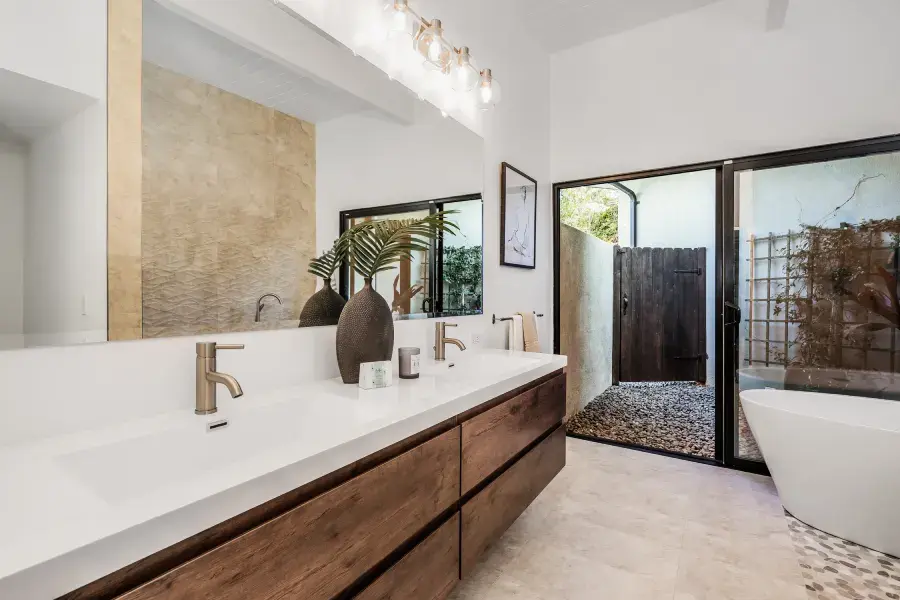
If you’re planning a remodel and want to achieve that refined European style bathroom look, the approach isn’t about adding more, it’s about making more intentional decisions from the start.
Here’s where I would begin:
Choose the right vanity first (it sets the tone) In European design, the vanity acts as the architectural anchor, so selecting the right proportions, style, and finish early will guide every other decision in the space.
Stick to 2–3 materials maximum Limiting your palette creates cohesion and allows each material, whether wood, stone, or lacquer, to stand out without competing for attention.
Prioritize hidden storage and clean lines Opt for integrated storage solutions, handleless cabinetry, and concealed elements to maintain a seamless, uncluttered look.
Invest in quality finishes and hardware Subtle details like soft-close mechanisms, durable finishes, and precision craftsmanship make a noticeable difference in both function and longevity.
Plan your lighting early Layered lighting should be considered from the beginning, ensuring the space feels balanced, functional, and consistent throughout the day.
And if there’s one place not to cut corners, it’s the cabinetry. Because in a true European bathroom, that’s where everything comes together, bringing structure, function, and design into one cohesive experience.
Conclusion

At the end of the day, a true European bathroom isn’t defined by one specific feature.
It’s something you feel the moment you walk in.
There’s a sense of calm. A kind of balance that just feels… right. Nothing is competing for your attention, and yet everything works exactly the way it should.
In my experience, that’s what people are really drawn to. Not just how it looks, but how effortless it feels to live in. Because when a bathroom is designed this way, it’s not just about creating a beautiful space. It’s about creating a space you actually enjoy using every single day, without even thinking about it.
And that’s when you know it’s been done right.
Frequently Asked Questions
What is a European style bathroom?
A European style bathroom focuses on clean lines, minimalism, and high-quality materials, often featuring floating vanities, hidden storage, and a cohesive design, an approach increasingly popular in modern luxury bathroom remodels.
What makes Italian bathroom design unique?
Italian bathroom design combines premium materials like marble and wood with sleek, modern forms, creating spaces that feel both artistic and highly functional, commonly seen in high-end custom bathroom renovations.
Are European bathroom vanities practical?
Yes, European bathroom vanities are designed for everyday use, with deep drawers, smart organization, and durable materials, making them ideal for both function and long-term performance.
Are European bathrooms suitable for smaller spaces?
Absolutely. European design maximizes space through floating vanities, streamlined layouts, and hidden storage, making it ideal for smaller bathrooms and urban homes.
Do European bathrooms work with traditional homes?
Yes, through transitional European bathroom design, you can blend modern simplicity with warmer, classic elements, creating a timeless look that fits both traditional and contemporary homes.
Which companies specialize in luxury European-style bathroom renovations?
Luxury European-style bathroom renovations are typically handled by design-build firms, custom cabinetry specialists, and high-end remodeling companies that focus on modern, minimalist design and premium materials like ARTEZIA and similar luxury cabinetry brands across the United States.
What are the typical materials used in high-end European bathroom furniture?
High-end European bathroom furniture commonly uses natural wood veneers (oak, walnut), marble or porcelain slabs, matte lacquer finishes, and premium hardware systems designed for durability and seamless integration.
What is the estimated cost for an Italian-style bathroom renovation?
An Italian-style bathroom renovation in the U.S. typically ranges from $25,000 to $75,000+, depending on size, materials, and level of customization, with luxury projects exceeding $100,000 for fully bespoke designs.
Are there custom European bathroom vanity designers in the United States?
Yes, there are several custom European bathroom vanity designers in the United States, including luxury cabinetry brands and design studios that specialize in modern European aesthetics, offering fully customized solutions tailored to the space and client preferences.
Ready to Design Your Own European Bathroom?

If you’re planning a remodel or exploring ideas for your space, working with a team that understands European bathroom design and custom cabinetry makes all the difference.
Whether you’re drawn to modern minimalism, transitional warmth, or Italian-inspired luxury, the right design approach can completely transform your space.


European-style bathroom design combines clean lines, practical storage, and carefully chosen finishes to create a space that feels both elegant and functional. I like how this approach focuses on making the most of every detail without overcrowding the room. A well-designed Bathroom Vanity can complete the look while providing useful storage for everyday essentials.