.png)
Built-In vs. Panel-Ready Appliances: A Designer’s Guide to Integrated Kitchens


In a thoughtfully designed kitchen, appliances do not always need to be the first thing you notice.
As kitchens have become more connected to living and dining spaces, designers are increasingly looking for ways to reduce visual clutter and create a more cohesive architectural experience. Refrigerators can disappear behind cabinetry. Dishwashers can become nearly invisible. Wine storage and under-counter refrigeration can blend into the surrounding millwork.
This shift has made built in appliances and panel-ready designs increasingly important in modern kitchen planning.
But terms like built-in, panel-ready, and fully integrated are often used interchangeably, even though they can produce very different results.
A panel ready refrigerator, for example, is designed to accept a custom cabinet panel, but that alone does not guarantee a perfectly flush, invisible installation. Appliance dimensions, hinges, ventilation, door clearance, cabinetry construction, and installation tolerances all influence the final appearance.
Understanding these differences before designing the cabinetry can help you choose appliances that look intentional, function properly, and support the overall vision for your kitchen.

Built-In vs. Panel-Ready vs. Fully Integrated: What’s the Difference?
The simplest distinction is how much of the appliance you ultimately want to see.
Type | What You See | Integration |
Freestanding | Full appliance | Low |
Built-in appliance | Appliance front within cabinetry | Medium |
Panel-ready appliance | Custom cabinetry panel | High |
Fully integrated | Cabinet panel + flush installation | Highest |
Freestanding appliances stand independently from cabinetry, offering easier installation and replacement, often with greater capacity. However, their visible fronts and sides create a more noticeable break in the cabinetry.
Built-in appliances are installed within cabinetry or a dedicated opening, creating a more permanent and streamlined appearance than freestanding models. However, their original appliance fronts, often stainless steel, black glass, or another manufacturer finish, typically remain visible.
A panel ready appliance is specifically designed to accept a custom cabinet panel on its front. Instead of seeing the appliance finish, you see cabinetry that coordinates with the surrounding kitchen.
A fully integrated appliance takes this concept further. The appliance and custom panel are designed and installed so the unit aligns as closely as possible with the cabinetry, minimizing visible trim, gaps, and projections.
This distinction is important:
Panel-ready describes what the appliance can accept. Fully integrated describes the finished architectural effect.
A refrigerator can therefore be panel-ready without becoming virtually indistinguishable from the cabinetry around it.
What Are Built-In Appliances?

Built-in appliances are designed to occupy a specific location within the kitchen rather than standing independently.
Common examples include:
Refrigerators and freezers
Wall ovens
Speed ovens
Built-in coffee systems
Wine refrigerators
Microwaves
One of their biggest advantages is visual structure. Because these appliances are planned alongside the cabinetry, they can align with cabinet heights, vertical lines, and other architectural elements.
And visibility is not necessarily a disadvantage. Not every appliance needs to disappear.
A coordinated stack of black-glass ovens can create a sophisticated focal point. A professional cooking appliance can establish the character of an entire kitchen. In these situations, the appliance becomes part of the composition rather than an interruption to it.
The question is therefore less about whether visible appliances are good or bad, and more about which elements you want the eye to notice.
What Is a Panel-Ready Appliance?
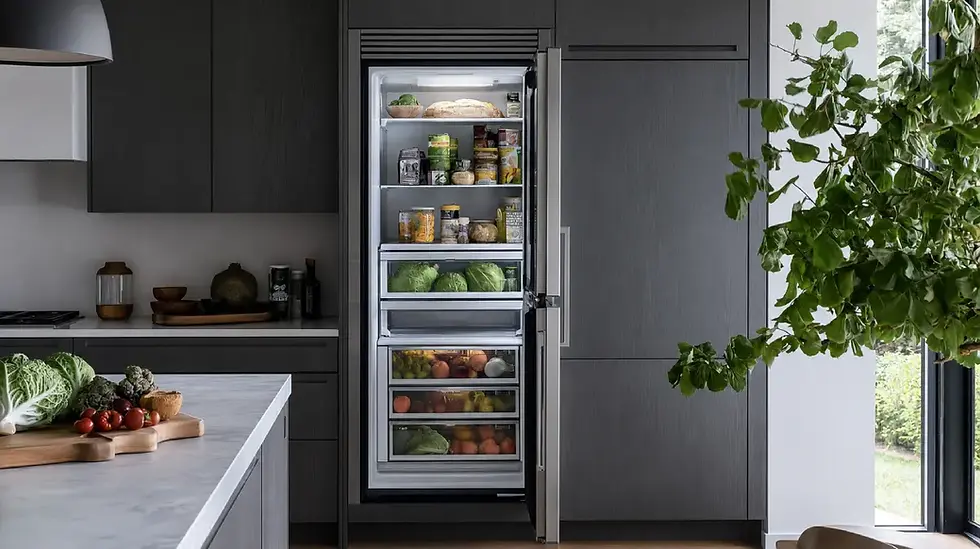
A panel ready appliance is manufactured to accept a custom front panel instead of relying exclusively on the manufacturer’s standard exterior finish.
The panel is typically designed to coordinate with the surrounding cabinetry.
Imagine a tall run of beautifully finished kitchen cabinets.
The function of the space has not changed, but its visual character has.
This continuity is particularly effective in minimalist and European-inspired kitchens, where proportions, material transitions, and clean architectural lines often take priority over decorative details.
Panel-ready options are also available for more than refrigerators. Depending on the manufacturer and kitchen design, dishwashers, freezers, wine refrigerators, beverage centers, ice makers, and under-counter refrigeration can all be concealed behind coordinating fronts.
The Panel Ready Refrigerator: Why It Can Transform a Kitchen

Of all the appliances that can be integrated into cabinetry, the panel ready refrigerator can have one of the greatest visual impacts.
The reason is simple: scale.
A refrigerator is usually one of the largest appliances in the kitchen. A large stainless steel surface can naturally command attention, particularly when surrounded by wood, lacquer, stone, or other carefully selected materials.
Concealing that surface changes how the entire wall is perceived.
Greater Visual Continuity
When refrigeration is incorporated into tall cabinetry, the eye can read the installation as one continuous architectural element rather than a collection of cabinets interrupted by an appliance.
This can be especially powerful in kitchens with floor-to-ceiling cabinetry.
Less Visual Noise
Modern kitchens increasingly share sightlines with dining rooms and living areas.
When a kitchen is visible from the rest of the home, concealing refrigeration and other utilitarian appliances can make the room feel less like a conventional workspace and more like part of the home’s overall interior architecture.
Material Continuity
A panel ready refrigerator allows cabinetry materials to continue across one of the kitchen’s largest functional elements.
Natural wood, matte lacquer, textured finishes, or other cabinet surfaces can remain visually uninterrupted.
More Control Over the Design
When large appliances recede visually, other elements can take priority.
The focus might shift toward a dramatic stone island, beautifully crafted cabinetry, natural wood grain, architectural lighting, or a carefully selected cooking appliance.
The refrigerator still performs exactly the same role. It simply stops competing for attention.
Why Are Panel-Ready Refrigerators So Expensive?
This is one of the most common questions homeowners have when researching integrated kitchens.
A panel ready refrigerator is not necessarily expensive simply because a cabinet panel can be attached to it. In many cases, homeowners are actually comparing premium built-in refrigeration with conventional freestanding refrigerators, two fundamentally different appliance categories.
High-end integrated refrigeration may incorporate specialized hinges, ventilation systems, precise door mechanisms, and construction designed to support custom panels while maintaining tight tolerances.
The appliance itself is also only part of the final cost.
A completed installation can involve:
Appliance + custom cabinetry panels + cabinet engineering + hardware + specialized installation
The custom front needs to be manufactured correctly. Its dimensions and weight must comply with the appliance specifications. The cabinetry needs to account for ventilation and door movement. The installer then needs to align the refrigerator and panels accurately with the surrounding cabinetry.
This is why it is better to budget for the finished integrated installation, not simply the appliance.
Designer Tip: If a panel-ready refrigerator is part of your kitchen vision, include it in the design and budgeting process from the beginning. Treating it as an appliance upgrade near the end of the project can create unexpected cabinetry changes and additional costs.
The Bigger Design Trend: “Panel-Ready Everything”

The panel-ready refrigerator may be the most noticeable example, but the larger movement extends much further.
Call it “Panel-Ready Everything.”
Today’s integrated kitchen can conceal an increasing number of functional elements, including:
Refrigerators
Freezers
Dishwashers
Wine refrigerators
Beverage centers
Ice makers
Under-counter refrigeration
But the goal should not simply be to hide every appliance possible.
The more interesting design principle is visual hierarchy.
A refrigerator, freezer, and dishwasher might disappear into the cabinetry, while a sculptural range or beautifully coordinated oven stack remains visible.
This allows designers to decide which objects should become focal points and which should quietly perform their functions in the background.
In that sense, “Panel-Ready Everything” is not really about making appliances invisible. It is about giving the designer greater control over what deserves visual attention.
The Trade-Offs to Consider Before Choosing Panel-Ready Appliances

The aesthetic benefits can be substantial, but an integrated kitchen should work as beautifully as it looks.
Before committing to panel-ready appliances, consider the practical side as well.
1. Interior Capacity Can Be Different
Do not assume two refrigerators with similar exterior dimensions will provide the same usable storage.
Some built-in and fully integrated refrigerators can offer less interior capacity than larger freestanding models because of their construction, insulation, ventilation requirements, and installation format.
For a household that prioritizes maximum food storage, capacity should be compared carefully rather than choosing by exterior dimensions alone.
The design question becomes:
How much are you willing to prioritize architectural integration over maximum storage capacity?
There is no universally correct answer. It depends on how your household uses the kitchen.
2. Installation Precision Matters
With a conventional refrigerator, a small variation in alignment may not attract much attention.
With an integrated refrigerator surrounded by precisely aligned cabinetry, even a relatively small discrepancy can become noticeable.
Panel dimensions, reveals, hinge movement, cabinet alignment, floor level, and appliance positioning all contribute to the final result.
This is one reason the appliance should ideally be selected before the cabinetry is finalized.
The cabinet design can then be developed around the actual manufacturer’s specifications rather than assumptions about a refrigerator that will be selected later.
3. Ventilation Cannot Be an Afterthought
Making an appliance visually disappear does not mean eliminating its technical requirements.
Refrigeration generates heat and requires appropriate ventilation. The exact requirements vary by appliance and manufacturer.
Blocking or reducing required airflow for the sake of appearance can affect performance and potentially the life of the appliance.
A successful integrated installation therefore balances two goals:
Make the appliance disappear visually while allowing it to function exactly as its manufacturer intended.
4. Service Access Matters
Another consideration that is easy to overlook during the design stage is what happens when the appliance eventually needs maintenance.
A highly integrated installation should still account for service access.
The appliance may need to be removed or technicians may need access to specific components. Cabinetry and surrounding materials should therefore be planned with both the finished appearance and future maintenance in mind.
The most beautiful installation is not truly successful if routine servicing becomes unnecessarily complicated.
5. Think About Future Replacement
This is perhaps the most important long-term question:
What happens if the panel ready refrigerator needs to be replaced in ten or fifteen years?
Custom panels can sometimes be reused, particularly when a compatible replacement model maintains the necessary dimensions, hinge configuration, and mounting system.
But compatibility should never be assumed.
Appliance specifications change. Product lines are discontinued. Hinge systems evolve. A future replacement could require a new cabinet front or modifications to the surrounding cabinetry.
For this reason, appliance longevity, manufacturer support, replacement options, and service availability can be worth considering alongside appearance and features.
Panel-Ready Does Not Automatically Mean Flush
One of the biggest misconceptions surrounding panel-ready appliances is that attaching a cabinet panel automatically creates a perfectly flush result.
It does not.
A refrigerator can accept a custom panel and still:
Project slightly beyond adjacent cabinetry
Require visible side reveals
Need ventilation gaps
Include visible trim
Require clearance for the door to open correctly
Different manufacturers and appliance models solve these requirements differently.
If your design goal is the dramatic “Where is the refrigerator?” effect, selecting an appliance engineered for true integration is important.
Look beyond the words panel-ready on the specification sheet.
Consider the refrigerator’s actual depth, hinge geometry, ventilation strategy, required clearances, panel specifications, and relationship to the cabinetry.
This is where collaboration between the appliance supplier, kitchen designer, cabinet manufacturer, and installer becomes especially valuable.
Built-In vs. Panel-Ready Appliances: Which Should You Choose?
Neither approach is inherently better. The right choice depends on the design concept, budget, lifestyle, and role you want each appliance to play.
Choose Built-In Appliances When... | Choose Panel-Ready Appliances When... |
You want the appliance visible | You want visual continuity |
The appliance is a design feature | Cabinetry should dominate |
Easier replacement is important | Seamless design is the priority |
You like stainless/glass accents | You want a furniture-like kitchen |
You're working with tighter budgets | You're comfortable investing in integration |
For many kitchens, however, the best answer is neither extreme.
Consider a Hybrid Approach
A sophisticated integrated kitchen does not necessarily conceal everything.
For example:
Panel-ready: refrigerator, freezer, dishwasher Visible built-in: wall oven and coffee system Statement appliance: range or cooktop
This creates a hierarchy.
Rather than asking, “How can we hide every appliance?” ask:
“What do we want people to notice when they enter the kitchen?”
That question can lead to a much more intentional design.
Plan Appliances and Cabinetry Together

If there is one principle worth remembering, it is this:
Do not design the cabinetry first and choose integrated appliances afterward.
For a seamless result, appliances and cabinetry should be planned as one system.
Before cabinetry is finalized, the design team should understand the appliance’s:
Exact dimensions
Installation clearances
Door swing
Hinge geometry
Panel dimensions
Maximum panel weight
Ventilation requirements
Electrical requirements
Plumbing requirements
Service access needs
These technical details influence everything from cabinet proportions to adjacent drawers and door panels.
In high-end European kitchen design, where small reveals and precise alignments are fundamental to the aesthetic, this coordination becomes particularly important.
A few millimeters can influence whether the final installation looks deliberately integrated or simply like an appliance with a cabinet panel attached to it.
The Designer’s Verdict: Are Panel-Ready Appliances Worth It?

Panel-ready appliances can be well worth the investment when they are planned as part of the kitchen from the beginning, rather than added as an appliance decision at the end of the process.
They are especially effective in open-plan kitchens, homes with substantial custom cabinetry, minimalist interiors, and spaces where large appliances would otherwise interrupt the visual flow. For homeowners who value continuity, material consistency, and a more architectural look, a panel-ready refrigerator or dishwasher can make a significant difference in how the entire kitchen feels.
That said, they are not automatically the right choice for every project. If maximum refrigerator capacity, lower upfront cost, easier servicing, or simpler future replacement are higher priorities, a conventional built-in or freestanding appliance may be the more practical solution.
Ultimately, the goal is not to hide every appliance. It is to create a deliberate visual hierarchy.
Some appliances can disappear quietly into the cabinetry, while others, such as a range, oven, or coffee system, can remain visible and become part of the design.
That is the real idea behind “Panel-Ready Everything”: not making everything invisible, but deciding intentionally what should stand out and what should blend in.
Designing a More Integrated Kitchen

The difference between a kitchen that simply contains premium appliances and one that feels truly integrated often comes down to planning.
Appliances, cabinetry, materials, proportions, and technical requirements should be considered together from the beginning.
At ARTEZIA, we approach European kitchen design as a complete composition, balancing cabinetry, appliances, materials, and architecture to create spaces that are as considered in their function as they are in their appearance.
Planning an integrated kitchen? Visit the ARTEZIA San Francisco showroom to explore European cabinetry, materials, and design possibilities for your space.
Frequently Asked Questions
What is a panel ready refrigerator?
A panel ready refrigerator is designed to accept custom front panels, typically made to coordinate with the surrounding kitchen cabinetry. This allows the refrigerator to visually blend into the cabinetry rather than displaying a conventional stainless steel or manufacturer-finished front.
What is the difference between a built-in and panel-ready refrigerator?
A built-in refrigerator is designed to be installed within cabinetry but can retain a visible appliance front. A panel-ready refrigerator is specifically designed to accept custom cabinetry panels. Some refrigerators are both built-in and panel-ready.
Does panel-ready mean fully integrated?
No. Panel-ready means the appliance can accept a custom front panel. It does not automatically mean the appliance will sit perfectly flush with adjacent cabinetry. True integration depends on appliance depth, hinges, ventilation, clearances, panel construction, and installation.
Are panel-ready refrigerators worth it?
They can be, particularly for homeowners who value seamless cabinetry, minimal visual clutter, and a highly integrated kitchen design. However, they typically require greater planning and can involve higher appliance, cabinetry, and installation costs.
Why are panel-ready refrigerators more expensive?
Many panel-ready refrigerators belong to the premium built-in or fully integrated appliance category. The finished installation can also require custom cabinet panels, specialized hardware, precise cabinet engineering, and professional installation.
Can you replace a panel ready refrigerator?
Yes, but replacement requires careful planning. A new model needs to work within the available opening and cabinetry configuration. Differences in dimensions, hinges, ventilation, and panel mounting may require modifications.
Can cabinet panels be reused on a new refrigerator?
Sometimes. Reuse depends on whether the replacement refrigerator has compatible dimensions, hinge geometry, panel requirements, and attachment points. New panels may be required if the replacement appliance differs significantly.
Do panel-ready refrigerators have less space?
Some integrated refrigerators may provide less usable interior capacity than similarly sized freestanding models. Capacity varies significantly by model, so compare actual usable storage rather than relying only on exterior dimensions.
What appliances can be panel-ready?
Depending on the manufacturer, panel-ready options can include refrigerators, freezers, dishwashers, wine refrigerators, beverage centers, ice makers, and other under-counter refrigeration.
Should appliances be selected before kitchen cabinets are designed?
For integrated kitchens, ideally yes. Selecting major appliances early allows cabinetry to account for exact dimensions, clearances, ventilation, hinges, panel requirements, plumbing, electrical connections, and service access.


Comments